
The global oil market is already under pressure. However, a new development is adding another layer of uncertainty. The United Arab Emirates has announced that it will exit OPEC+ starting May 2026. At first glance, this may seem like just another policy shift. In reality, it comes at a time when the Iran-Israel-US conflict is already disrupting oil flows. As a result, this decision could have both immediate and long-term implications for oil prices, supply stability, and global energy markets.
Breakdown:
To understand the impact, it is important to first understand what OPEC+ represents. OPEC, formed in 1960, is a group of oil-producing countries that coordinate production to maintain stable prices. Over time, this expanded into OPEC+, which includes additional producers such as Russia. Together, the bloc accounts for nearly 50 percent of global oil and oil liquids production, making it one of the most influential forces in energy markets.
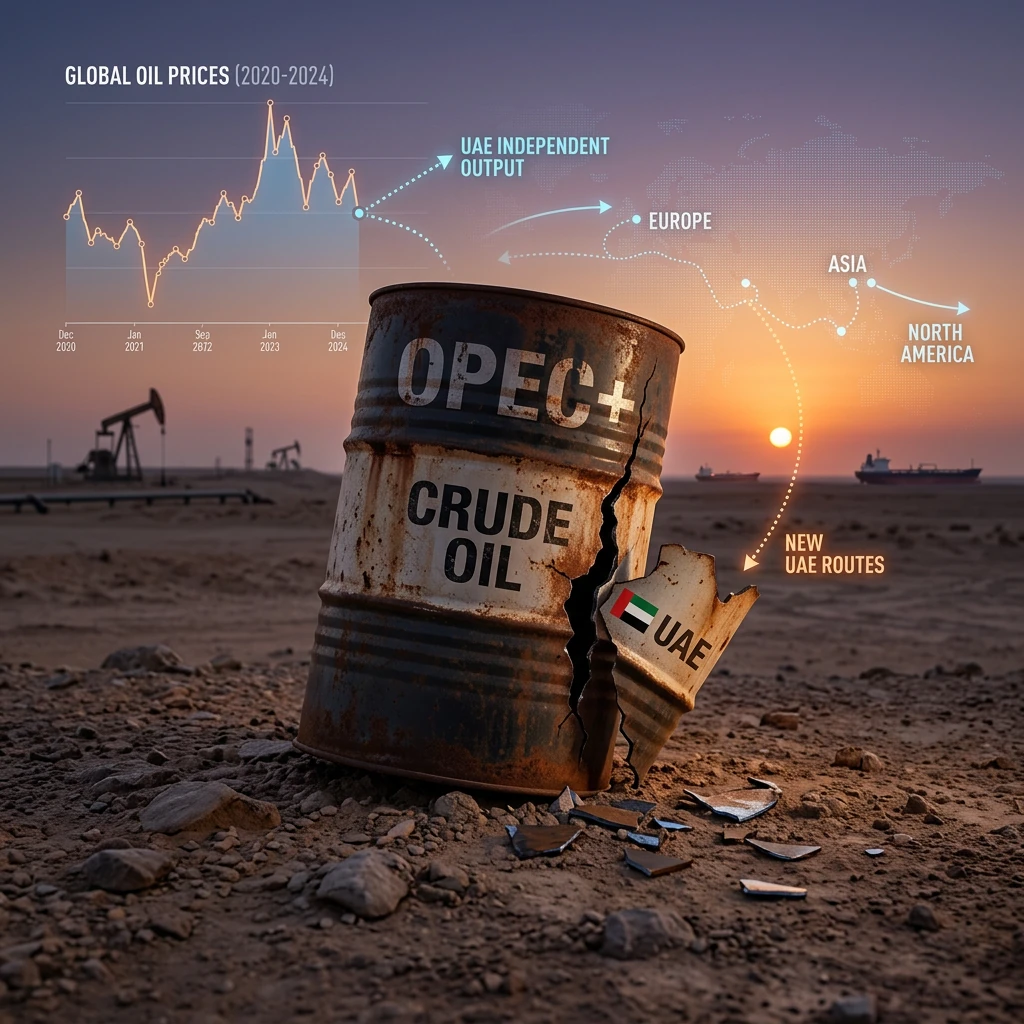
The UAE’s exit is significant because it is not a small player. It is one of the larger producers within the bloc, and its departure weakens the group’s ability to control supply. Traditionally, OPEC+ manages production levels to stabilise prices. However, when a major member leaves, that coordination becomes harder. As a result, markets may start reacting more to individual country decisions rather than collective strategy.
At the same time, this move comes during an already volatile period. The Strait of Hormuz, one of the world’s most critical oil routes, is effectively disrupted due to the ongoing conflict. This has already reduced oil flows from the region by millions of barrels per day. Consequently, supply constraints and geopolitical risks are already driving uncertainty in prices.
However, the UAE’s position introduces a different dynamic. By stepping out of OPEC+, it gains the flexibility to increase production independently. Over time, this could lead to higher supply in global markets, which may put downward pressure on prices. At the same time, it also reduces the price stability that OPEC+ typically provides, increasing overall volatility.
Another important factor is infrastructure. The UAE’s Fujairah port allows it to bypass the Strait of Hormuz for some exports. While this gives it a strategic advantage, the capacity is still limited compared to its total production potential. As a result, even with independence, logistical constraints will continue to shape how much oil can actually reach global markets.
Why this matters:
This development changes how oil markets respond to both policy and conflict. Instead of relying on coordinated decisions from OPEC+, the market may become more fragmented, with individual producers acting independently. As a result, price movements could become more volatile, especially during geopolitical crises. At the same time, this creates both risks and opportunities for economies that depend on oil imports or exports.
The Big Picture:
More broadly, this signals a shift in global energy dynamics. OPEC+ has long acted as a stabilising force in oil markets by balancing supply and demand. However, as members begin to diverge in their interests, that influence may weaken. Combined with geopolitical tensions and evolving energy strategies, the oil market is moving toward a more complex and less predictable structure.
The Crunch:
Oil markets do not just react to supply. They react to control. With the UAE stepping away from OPEC+, the question is no longer just how much oil is produced, but who controls the decision to produce it.