
The global economy is shifting faster than most companies realise. Industries that barely existed twenty years ago now dominate the world’s top ten rankings. McKinsey calls these high velocity sectors “arenas of competition” and argues they are the true engines of disruption and growth. Twelve arenas defined the last two decades. Now eighteen new arenas are emerging, powered by AI, electrification, biotech, and hard tech. The takeaway is simple. You cannot compete in the future if you cannot see where the future is forming. And according to this research, it is forming right now.
Breakdown:
McKinsey’s analysis starts with a stark fact. The world’s most valuable companies in 2025 are almost entirely different from the leaders of 2005. Only one name survived the reshuffle. The others were replaced by companies operating in what McKinsey calls “arenas” high growth, high dynamism sectors like cloud, e-commerce, consumer electronics, semiconductors, and biopharma. These twelve arenas grew their market cap at nearly triple the pace of all other industries and attracted more R&D, more new entrants, and more global expansion. They also generated a disproportionate share of global economic profit, rising from 9 percent in 2005 to 35 percent in 2023.
1. The twelve arenas that dominated 2005 to 2023
These industries grew outrageously fast and shook up global rankings:
- Cloud services
- E-commerce
- Consumer electronics
- Semiconductors
- Consumer internet
- Software
- Biopharma
- Electric vehicles
- Payments
- Video and audio entertainment
- Industrial electronics
- Information-enabled business services
Across these twelve arenas:
- Market cap share almost tripled
- Economic profit share jumped from 9 percent to 35 percent
- Industry shuffle rates soared far above traditional sectors
- Nearly 40 percent of the market cap came from companies that barely existed in 2005
In short, arenas reward scale, speed, talent, and aggressive innovation.
2. What creates an arena in the first place
McKinsey calls it the arena-creation formula:
A. A step change in technology or business model: Streaming replaces DVDs. E-commerce replaces physical retail. Chips get fabless design.
B. Escalatory investment cycles: Big tech’s R&D plus capital spend grew from 13 billion dollars in 2005 to 503 billion dollars in 2024.
C. A huge global market: If the market is not big enough, it cannot become an arena.
These three forces create brutal competition and giant rewards.
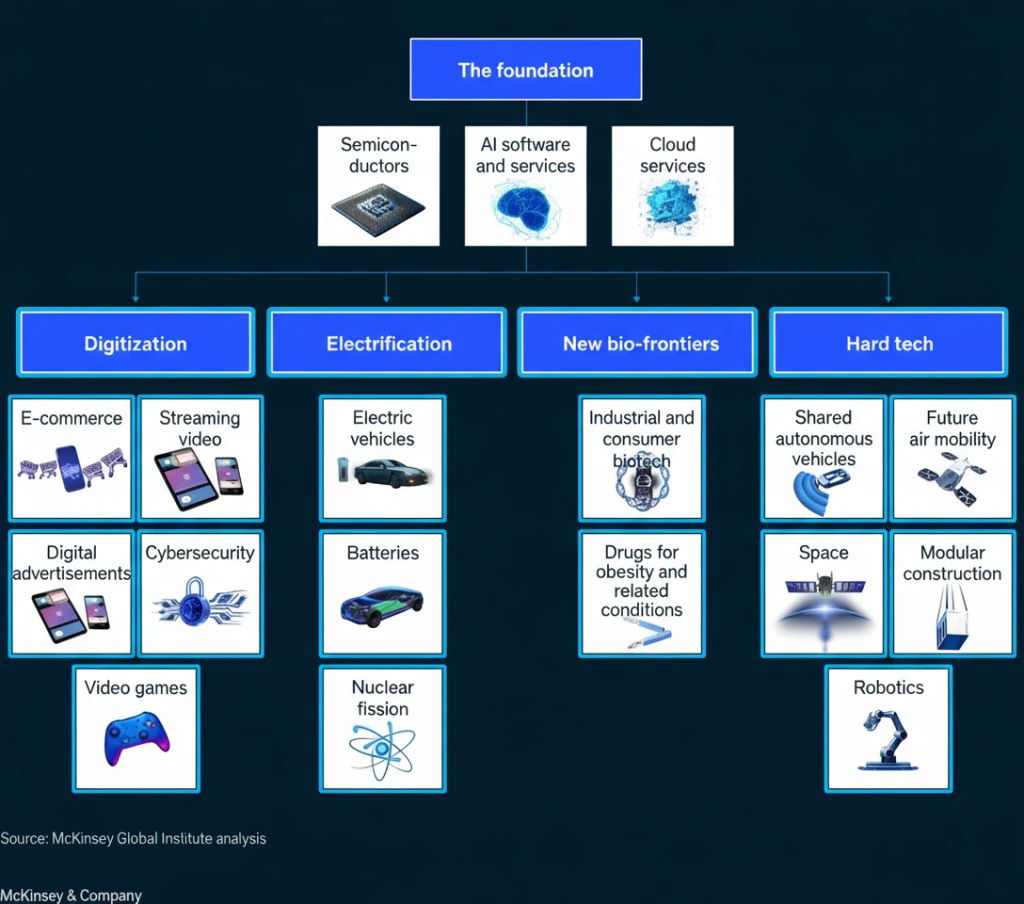
3. The eighteen emerging arenas that will define the next fifteen years
A. Foundation Arenas (the AI supercluster)
- Semiconductors
- AI software and services
- Cloud services
These three power everything else and determine the global pace of AI adoption.
B. Digitization
- E-commerce
- Digital ads
- Cybersecurity
- Streaming video
- Video games
C. Electrification
- Electric vehicles
- Advanced batteries
- Nuclear fission
D. New Bio-Frontiers
- Industrial biotech
- Consumer biotech
- Obesity and metabolic drugs
E. Hard Tech
- Shared autonomous vehicles
- Space
- Modular construction
- Robotics
- Future air mobility
These are the areas where innovation, investment, and talent are already converging.
4. The scale of what is coming
By 2040, these eighteen arenas could generate:
- Twenty nine to forty eight trillion dollars in annual revenue
- Two to six trillion dollars in annual profit
- Up to one third of total global GDP growth
Semiconductors will create outsized profit pools. EVs will explode in revenue but must solve their margin problem. Biotech and hard tech will be heavily shaped by AI.
5. Who controls the arena map today
- The United States controls 75 percent of all arena market cap
- China is strong in EVs, semiconductors, and consumer internet
- Europe is underrepresented, especially in digital and AI driven arenas
This distribution will shape geopolitics, supply chains, and regulation for the next decade.
6. Why companies need “arena radar”
McKinsey’s advice is simple. Every company must map itself to these arenas.
Key questions include:
- Are you competing in any arena today
- Are you at risk of being disrupted
- Can you adopt arena technologies to boost your own capabilities
- Are you a potential supplier to an emerging arena
- Are you investing early enough to ride the S curves
Arenas determine where value will be created and where legacy players will be replaced.
Together, these eighteen arenas could generate between twenty nine and forty eight trillion dollars in revenue by 2040 and up to six trillion dollars in profits. To put it bluntly, these sectors could account for up to a third of global GDP growth. Unsurprisingly, US companies dominate most arenas, controlling three fourths of total market cap, while China is strong in EVs, semiconductors, and consumer internet. Europe appears significantly underweight, especially in tech heavy categories.
Why this matters:
These arenas will decide which companies dominate global markets, which economies grow faster, and which skills become valuable. They will reshape job creation, investment priorities, infrastructure, and regulation. AI will accelerate every arena. Electrification will redefine energy and mobility. Biotech will transform healthcare and consumer products. Hard tech will rewrite physical industries that have not changed in decades. The speed of this shift means slow movers will not simply lose market share; they could lose entire categories.
The Big Picture:
We are entering a period where economic transformation is happening in clusters rather than isolated sectors. The AI supercluster, electrification wave, biotech revolution, and hard tech resurgence are converging. This creates massive opportunity but also massive risk. Every company, investor, and policymaker must track arenas closely because they are the closest thing we have to a roadmap for future value creation.
The Crunch:
The next fifteen years will not be won by the companies with the biggest factories or the longest history. They will be won by the companies that see the arenas forming and move early. The leaders of tomorrow are already positioning themselves. Everyone else is catching up.
McKinsey’s article lays out the landscape clearly. The full version is here:
https://www.mckinsey.com/mgi/our-research/capturing-the-next-big-arenas-of-competition-in-ten-charts