
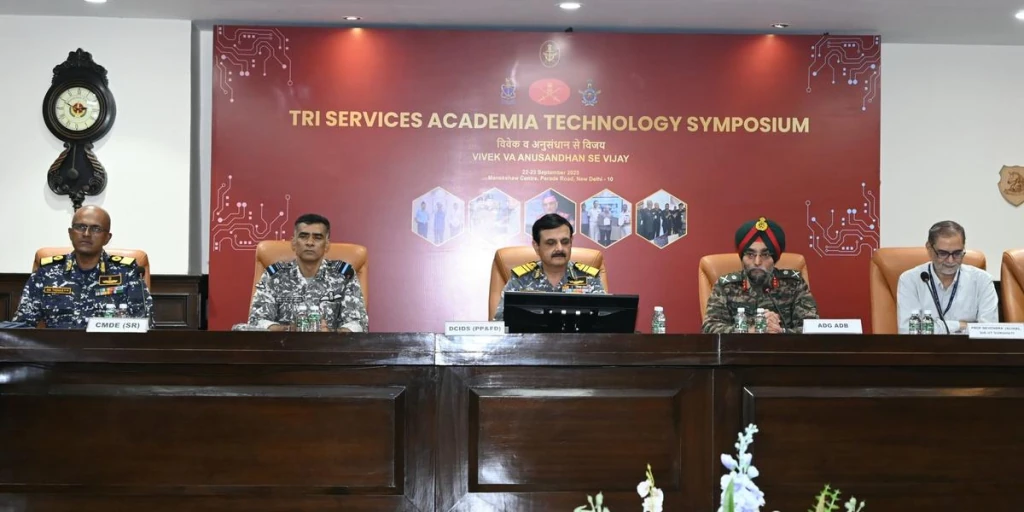
India’s armed forces have taken a decisive step toward closer collaboration with academia. The country’s first Tri Services Academia Technology Symposium (T-SATS) opened in New Delhi, bringing together the military and 62 academic institutions to co-create solutions for future warfare.
Breakdown
Context
The two-day symposium, themed “Vivek va Anusandhan se Vijay” (Victory through Wisdom and Research), marks a milestone effort to align military technology requirements with academic research and innovation. It is the first event of its kind to involve the Army, Navy, and Air Force collectively.
Angles
Chief of Defence Staff General Anil Chauhan inaugurated the summit, underscoring the urgent need for indigenous capabilities. He highlighted the convergence of kinetic and non-kinetic warfare, pointing to cyber, space, and electronic domains as critical frontiers.
What’s Next
With IITs, IIITs, and private institutes participating, the symposium is expected to seed partnerships that foster cutting-edge platforms, weapons, and network technologies. Future editions of T-SATS could evolve into a permanent forum for military–academic collaboration.
Why this matters
Modern warfare is increasingly tech-driven. Building domestic capabilities through academia and startups reduces dependence on foreign technologies, strengthens India’s defence preparedness, and creates spillover benefits for civilian industries.
The Big Picture
India is reimagining national security by embedding innovation into its defence ecosystem. T-SATS signals a long-term strategy: to merge research, industry, and military needs into a self-reliant framework for next-generation security solutions.