
India’s political debates are often loud, relentless, and deeply polarised. Elections, alliances, ideology, and identity dominate headlines almost every day. However, beneath the noise sits a far more urgent challenge that receives far less sustained attention: the condition of India’s cities. Congestion, flooding, water stress, pollution, failing infrastructure, and overstretched public systems are turning urban India into one of the country’s biggest long-term risks. As a result, the real fight shaping India’s future may not simply be political. It may be urban.
Breakdown:
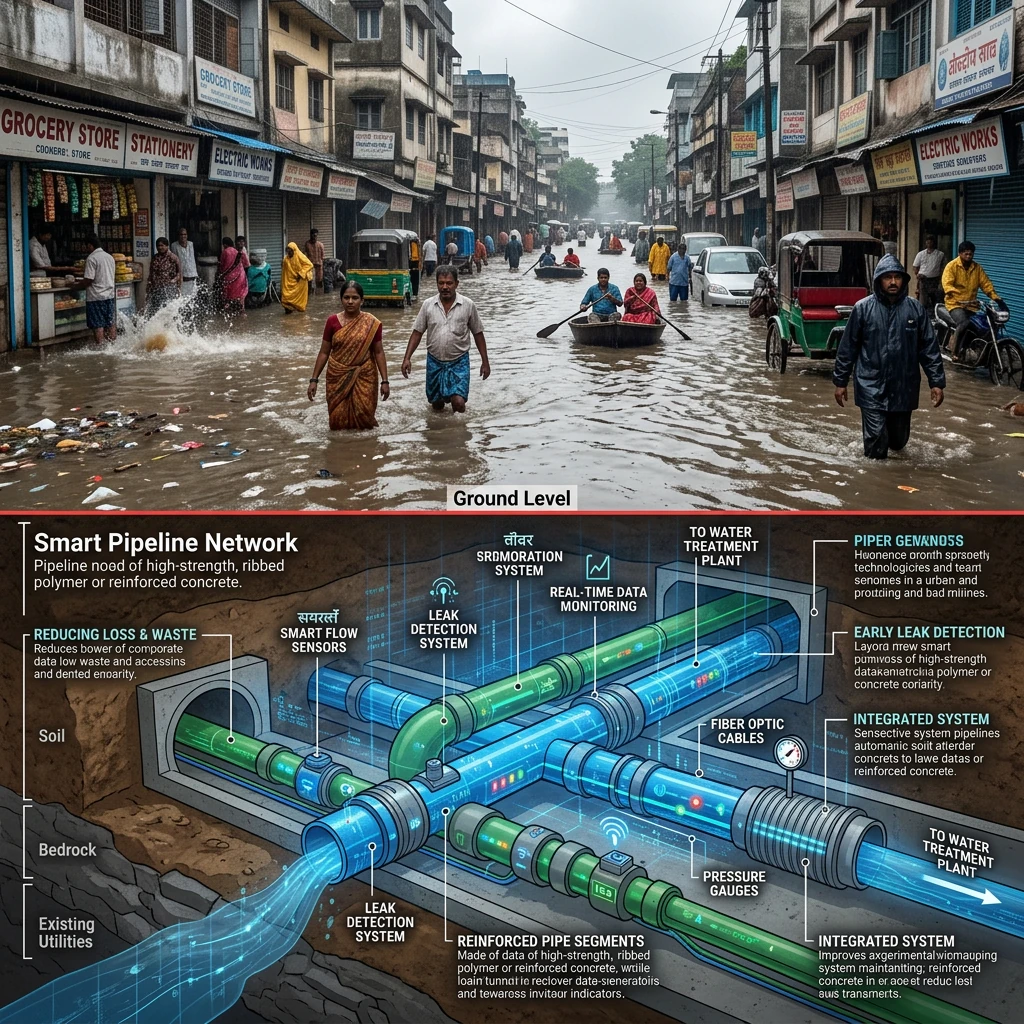
India is urbanising at extraordinary speed. Millions continue moving toward cities in search of jobs, education, business opportunities, and better living standards. However, infrastructure growth has struggled to keep pace. Roads remain overloaded, drainage systems collapse during heavy rains, air quality continues worsening, and affordable housing shortages push expansion into unplanned urban sprawl.
At the same time, another crisis is quietly building underneath cities themselves: water. Many Indian cities still rely on intermittent water supply systems instead of continuous pressurised networks. According to global health agencies, these systems significantly increase contamination risks because pollutants can enter pipelines whenever pressure drops. Combined with ageing infrastructure and weak maintenance systems, this creates fragile urban networks that often react only after failures occur.
Recent incidents have exposed those vulnerabilities clearly. Water contamination cases in cities such as Indore demonstrated how infrastructure failures can quickly become public health emergencies. Meanwhile, rapidly growing cities face mounting pressure from population growth, groundwater depletion, climate stress, and rising demand.
However, one city increasingly stands out as a different model. Puri, in Odisha, has implemented a continuous water supply system supported by upgraded treatment infrastructure and round-the-clock monitoring. Households there can reportedly drink directly from the tap, still rare across most Indian cities. More importantly, the city demonstrates how operational coordination, monitoring systems, and accountability can improve urban infrastructure reliability significantly.
This reflects a broader shift happening globally. Cities are slowly moving from reactive infrastructure systems toward predictive ones. Sensors, AI-based monitoring, automated leak detection, and real-time analytics now allow utilities to identify failures earlier and respond faster. Instead of waiting for flooding, contamination, or breakdowns to happen, systems can increasingly predict vulnerabilities before they escalate into crises.
The challenge in India is not only technological. It is structural. Urban governance remains highly fragmented across agencies responsible for roads, drainage, water, sanitation, transport, and public health separately. Municipal bodies often manage populations larger than many countries while operating with limited financial autonomy and weak planning capacity. Consequently, cities carry enormous economic responsibility without equivalent institutional strength.
The issue also intersects increasingly with politics itself. India’s future electoral redistricting and population-based seat redistribution debates may reshape political representation significantly over the coming decades. Northern and southern states are growing at very different rates, while urban populations continue expanding rapidly. As cities become larger economic engines, demands for better infrastructure, governance, and urban planning will likely become harder for political systems to ignore.
This matters because urban infrastructure is no longer simply a quality-of-life issue. It directly affects economic productivity, investment attractiveness, climate resilience, healthcare, logistics, and workforce efficiency. In many ways, the future competitiveness of Indian cities may determine the future competitiveness of India itself.
Neighbourhood quality also increasingly depends on operational reliability rather than premium branding alone. Reliable water, drainage, mobility, green spaces, internet connectivity, and public services now shape how people evaluate where they want to live. The most liveable neighbourhoods are often the ones where infrastructure simply works consistently.
India therefore faces a larger strategic question. Can the country modernise its cities fast enough to support its economic ambitions, or will collapsing urban systems gradually begin slowing growth itself?
Why this matters:
India’s long-term growth story depends heavily on whether its cities remain economically functional and operationally resilient. Urban infrastructure now directly affects productivity, public health, investment, climate adaptation, and overall quality of life. Without stronger cities, sustaining long-term economic growth may become increasingly difficult.
The Big Picture:
More broadly, India may be entering a phase where governance quality matters as much as economic growth rates. The next stage of development will likely depend less on headline GDP numbers alone and more on how efficiently cities move people, manage water, deliver services, and support business activity. Over time, urban governance may become one of the defining battlegrounds shaping India’s future.
The Crunch:
India’s future may not be decided only in Parliament. It may also be decided through traffic jams, flooded roads, water shortages, and failing urban systems.