
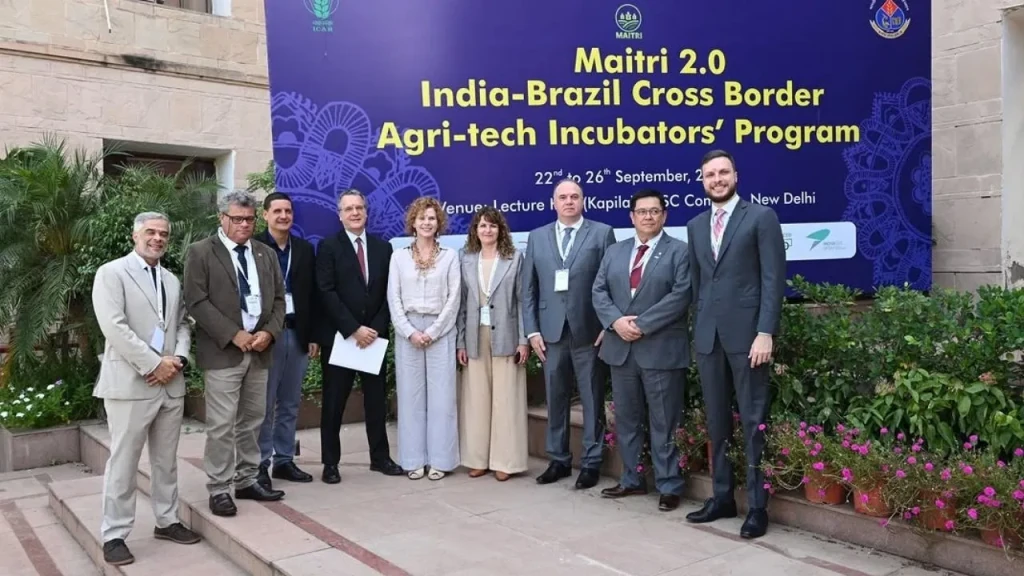
India and Brazil are strengthening their collaboration in agriculture through the launch of Maitri 2.0, a cross-incubation programme designed to drive agritech innovation and foster exchange of best practices. The initiative, unveiled in New Delhi, reflects the growing importance of technology in making farming more productive and sustainable.
Breakdown:
Context: The programme is led by the Indian Council of Agricultural Research (ICAR) in partnership with Brazilian research and innovation institutions. Maitri 2.0 builds on the success of the first edition, expanding opportunities for startups, researchers and entrepreneurs in both countries to collaborate.
Angles: The focus is on sharing solutions in areas such as crop productivity, climate resilience, water efficiency and precision farming. Brazil brings expertise in tropical agriculture and large-scale farming practices, while India contributes its strengths in smallholder-focused innovations and digital agriculture. Together, the partnership seeks to bridge knowledge gaps and create scalable models.
What’s Next: Selected startups and researchers from both countries will undergo incubation, mentoring and pilot testing under the programme. The outcomes could feed into bilateral trade discussions in agriculture and open new markets for agritech solutions.
Why this matters:
Agriculture is central to both economies, yet both face challenges such as climate change, resource constraints and productivity gaps. By combining strengths, India and Brazil can co-develop scalable innovations that not only benefit their farmers but also contribute to global food security.
The Big Picture:
International collaboration in agritech underscores a broader shift in global agriculture, where innovation is seen as key to solving systemic challenges. For India and Brazil, the partnership is not only about technology but also about positioning themselves as leaders in sustainable farming solutions for the Global South.