
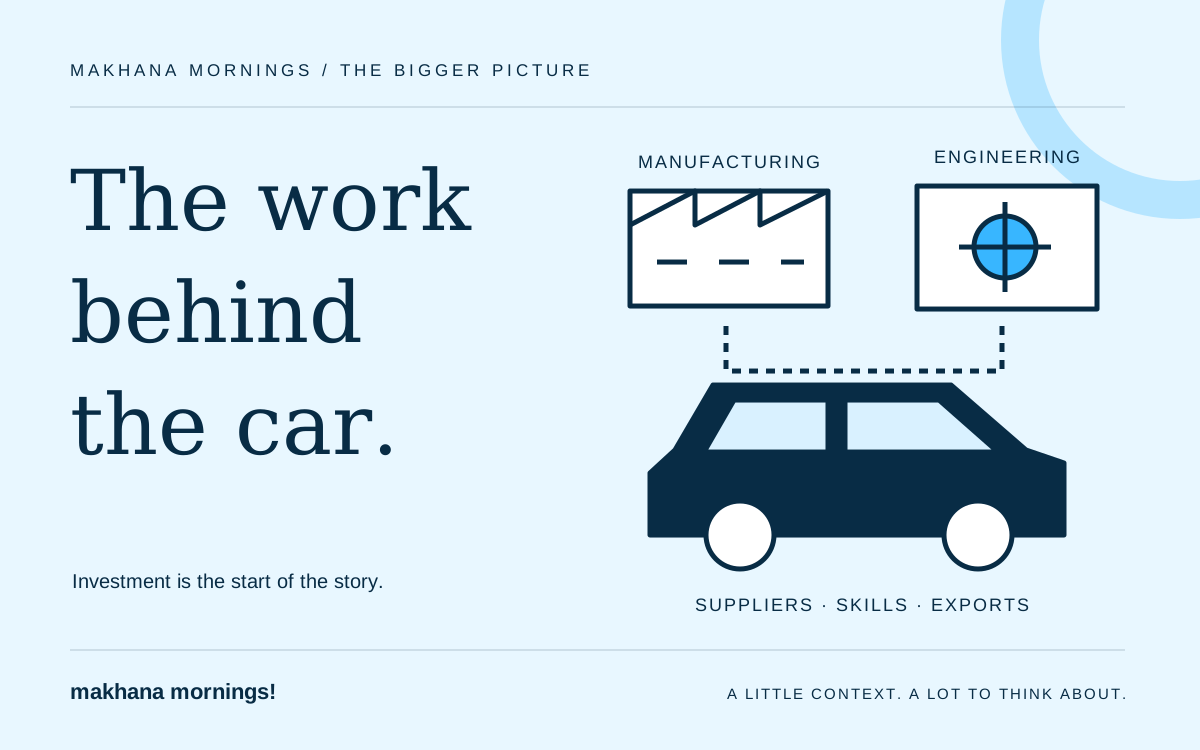
A car rolling out of a factory is the visible end of a much longer chain: designing parts, testing systems, making components and getting the finished vehicle to a buyer. Hyundai Motor Group’s latest India investment plan puts that whole chain in focus.
On October 13, the group announced a $15.5 billion programme for 2026–2032. A day later, Hyundai Motor India formally inaugurated its Pune plant. Together, the announcements raise a useful question: how much more of the work behind each car will happen in India?
The Breakdown
The programme spans manufacturing expansion at Hyundai Motor India and Kia India, supplier development, research and future mobility businesses. About $700 million is planned for the group’s Indian R&D centre, including a vehicle testing track. A dedicated investment entity will coordinate the wider effort.
The broad spending mix has also begun to take shape. In comments after the Pune inauguration, group leadership put around 60% towards upgrading facilities and expanding production capacity, and around 20% towards new businesses, including AI, ventures and startups.
At Pune, annual installed capacity is 170,000 vehicles, with expansion to 320,000 planned by 2030. There is an important date distinction here: passenger-vehicle production at Talegaon began on October 1, 2025. This week’s event was the formal inauguration.
There is also a money distinction. Hyundai Motor India had already announced a ₹45,000 crore investment roadmap through FY2030. The October 13 announcement did not explain how much of the new $15.5 billion total is additional to that earlier commitment. Adding the two would risk counting some spending twice.
Why This Matters
For an Indian component maker, the meaningful next step would be a contract: which part, how many units, to what specification, and over what period? That information determines whether it makes sense to buy equipment, qualify a new production process or train a team.
The same logic applies to engineering. A local testing track and larger research operation could allow more development and validation work to take place close to factories and suppliers. The opportunity becomes more valuable if local teams gain responsibility for solving design problems as well as carrying out production tasks.
Those are possible pathways, not outcomes established by the announcement. Supplier agreements, completed facilities and the work assigned to Indian teams will show how far the plan goes.
For jobseekers, the distinction matters too. The investment announcement points to more employment across manufacturing, engineering and supply chains, without putting a number on new jobs. A seven-year spending commitment should not be read as an immediate hiring forecast.
The Big Picture
India already combines a substantial home market with an export business. Domestic passenger-vehicle dispatches reached about 46.43 lakh in FY2025–26, while exports reached about 9.05 lakh, up 17.5% from the previous year. The reported industry series excludes BMW, Mercedes, JLR and Volvo Auto.
That creates two potential sources of demand for an India-based operation. It also makes the quality of the work important. A supplier able to meet the requirements of several markets may have a broader opportunity than one tied to a single local model. Whether that happens depends on product decisions, qualification standards and orders.
Installed capacity alone cannot settle the question. It describes what a plant can make; actual production and sales show how much of that ability is being used. Export ambitions also need customers abroad, reliable delivery and products that suit those markets.
The Crunch
The next useful checkpoints are concrete: a clearer spending schedule, an explanation of overlap with earlier commitments, supplier awards, R&D milestones and production volumes.
Hyundai’s plan gives India a substantial industrial opportunity. Its significance will become clearer as the money turns into equipment, engineering responsibility and sustained orders. Follow the work behind the cars, and the investment story becomes much easier to judge.