
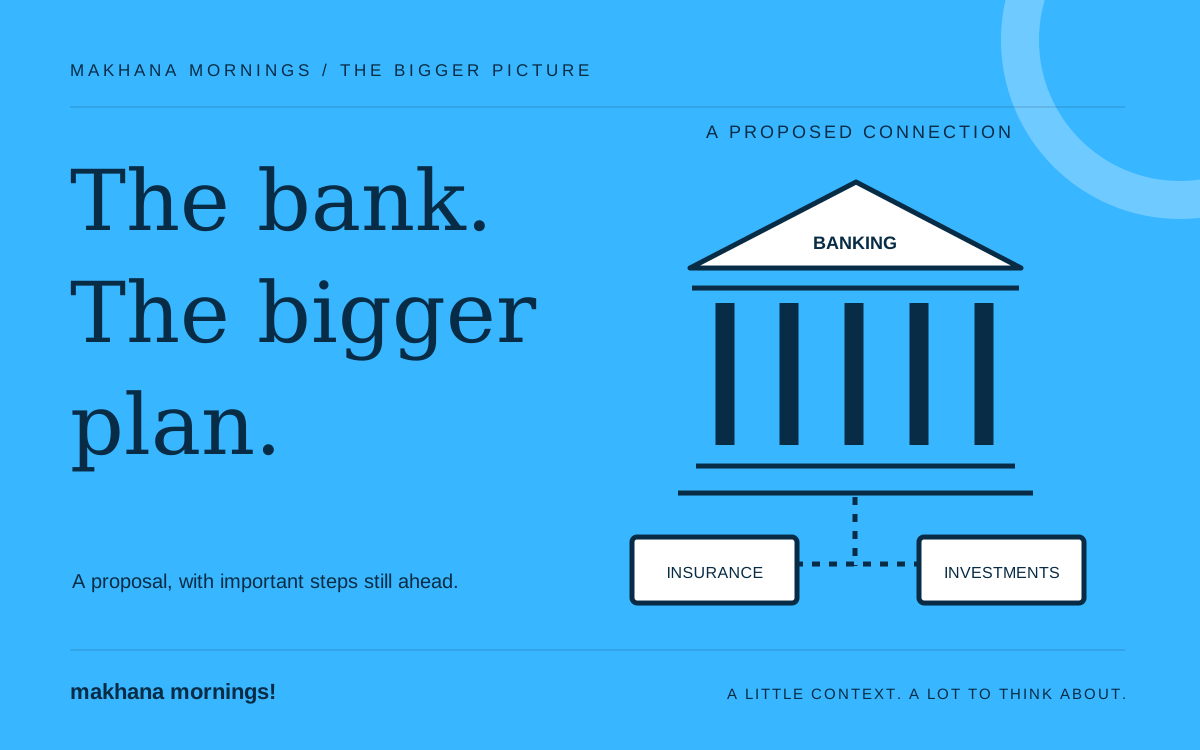
A bank branch gives a financial company something difficult to build from scratch: a continuing relationship with customers. Fairfax’s plan for IDBI Bank shows how valuable that relationship could become when savings accounts and loans sit alongside insurance and investment services.
On October 14, the government approved a Fairfax Financial Holdings subsidiary as the strategic buyer for a proposed 60.72% stake sale in IDBI Bank, worth about ₹52,878 crore. Fairfax then outlined a wider ambition involving its insurance interests and IIFL Capital Services.
The distinction between those steps is the story. An approved bidder, a completed bank acquisition and a broader financial-services group are separate milestones.
The Breakdown
The proposed bank purchase has two sellers. Under the proposal, the government would sell 30.48%, while Life Insurance Corporation of India would sell 30.24%. Their remaining holdings would be 15% and 19%, respectively.
That also means the headline cheque has two destinations. Roughly ₹26,543 crore would go to the government and ₹26,335 crore to LIC. Counting the entire ₹52,878 crore as cash raised for the Union budget would overstate the budget benefit.
Fairfax separately proposes transferring its interests in Go Digit Life Insurance and Go Digit General Insurance, together with Fairfax India’s interest in IIFL Capital Services, to IDBI Bank. The proposal concerns those shareholdings; it does not establish that the businesses have already merged operationally.
The October 14 proposal remains conditional: no binding definitive agreements had been signed for either the purchase or the proposed contributions at the time of the announcement. The bank acquisition could also proceed without one or both of the contribution transactions.
Why This Matters
The commercial logic is distribution. A customer already visiting a bank to save or borrow could become a potential customer for an insurance policy or a wealth-management service. For the financial businesses involved, that creates an opportunity to reach people through an established relationship rather than acquire every customer separately.
The practical benefit would depend on execution. Customers would need clear explanations of what they are buying, what it costs and which entity is responsible. A wider product menu is useful only when people can understand and compare it.
For the bank, expanding the range of services would require more than a common shareholder. Staff training, product suitability, customer support and technology connections would all matter. Those are operational tests that an ownership announcement cannot answer.
The proposed contributions require regulatory consideration, including from the Reserve Bank of India and the Securities and Exchange Board of India. The insurance proposal also needs the Insurance Regulatory and Development Authority of India’s approval. The final structure remains subject to the relevant permissions and agreements.
The Big Picture
IDBI’s journey explains why this is a consequential step. The bank entered the RBI’s corrective-action framework in 2017. LIC acquired a controlling stake in 2019, and the bank left that framework in 2021. A sale process launched in 2022 then passed through years of regulatory and bidding work.
The proposed price is ₹81 a share. The government assessed it against a ₹75.99 benchmark derived from two valuation methods. That explains how the bid was evaluated; it does not settle what the business will earn under a different owner.
The next phase therefore shifts attention towards completing the transactions and running the institution. Loan growth would need sound credit decisions. Additional financial products would need effective oversight. Any gains from a wider customer network would have to justify the costs of connecting and managing the businesses.
The Crunch
Watch for signed agreements, the final contribution terms and regulatory decisions. Then look for evidence in service quality, customer uptake and financial performance.
Fairfax has described an ambitious destination for IDBI Bank. The useful way to follow the deal is to track each transaction separately and judge the operating results as they arrive.