
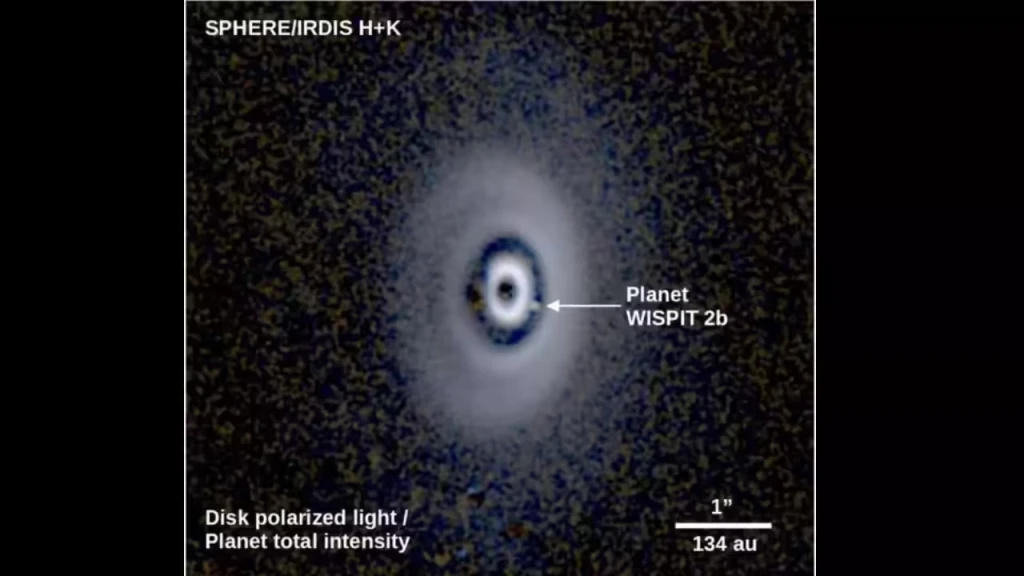
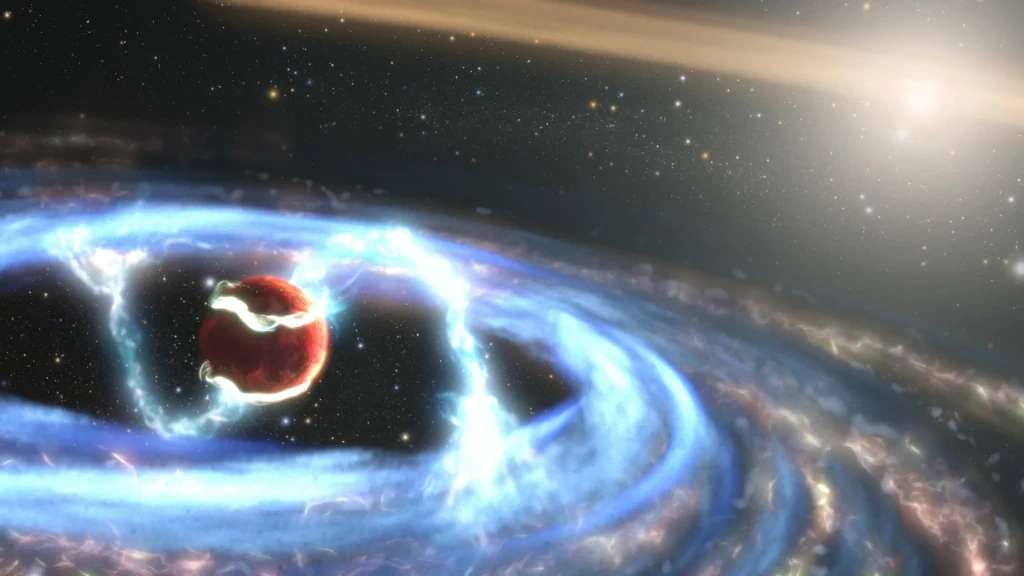
For the first time, astronomers have directly photographed a planet being born. The massive gas giant WISPIT 2b, located 437 light-years from Earth, is carving out a gap in the dusty ring around its host star, providing long-sought visual proof of how planets form. The finding validates decades of theories about protoplanetary disks and offers a rare opportunity to watch the universe building worlds in real time.
Breakdown:
Context:
For years, astronomers suspected that gaps in the rings of young stars were evidence of unseen planets forming, but direct proof was elusive. WISPIT 2b, about five times the mass of Jupiter and just 5 million years old, confirms this theory. Using the Magellan Telescope’s adaptive optics system in Chile, scientists detected the hydrogen-alpha light emitted as gas falls onto the growing planet, making WISPIT 2b appear as a purple dot inside the dust ring.
Angles:
The discovery was led by teams from the University of Arizona and Leiden Observatory and published in Astrophysical Journal Letters. Initial observations with the Very Large Telescope’s SPHERE instrument revealed the disk’s multi-ringed structure, prompting deeper investigation. Beyond WISPIT 2b, researchers identified another candidate, CC1, hinting at a multi-planet system in formation.
What’s Next:
Future studies will focus on how WISPIT 2b accretes material, evolves in orbit, and influences the disk around its star. Astronomers say this system could serve as a benchmark for understanding planetary birth and may even provide clues about how our own Solar System formed 4.5 billion years ago.
Why this matters:
This is the first visual confirmation of a planet shaping its environment, proving that planetary birth can be directly observed rather than inferred. It is a validation of decades of theoretical astrophysics and a milestone for observational astronomy.
The Big Picture:
Just as the first images of black holes reshaped our view of the universe, the capture of WISPIT 2b anchors theories of planetary formation in direct evidence. It opens the door for a new era of planet-hunting, where telescopes can watch solar systems assemble in real time.
The Crunch:
Astronomy has moved from speculation to observation. Seeing a planet emerge from dust confirms the predictive power of physics and technology, while reminding us that systems like ours are not unique, they are part of a universal process still unfolding in the cosmos.